Four months into baseball’s infamous 1994 player’s strike — a strike that saw the final 49 regular season games, playoffs, and World Series canceled for the first time in history — Astros owner Drayton McLane felt the need to cut costs.
Nothing done during the strike would be officially ‘official’ until the season resumed, including trades, but teams were free to trade during what would have been the normal off-season.
Astros general manager Bob Watson was told to cut costs in a BIG way, dealing away rising and ancillary players due for large pay raises in the near or immediate future after the team’s major free agent signings of 1993, pitchers Doug Drabek and Greg Swindell, backfired spectacularly.
It may have also had something to do with the notion that perhaps people might be a bit upset once baseball did return as a result of the strike, leading to lower gate numbers and all-around revenue. Perhaps.
There was no better natural partner for a massive cost-cutting endeavor than the San Diego Padres, who were led by general manager Randy Smith, son of then-Astros president, Tal Smith, team president Larry Lucchino, and enthusiastic new club owner, John Moores.
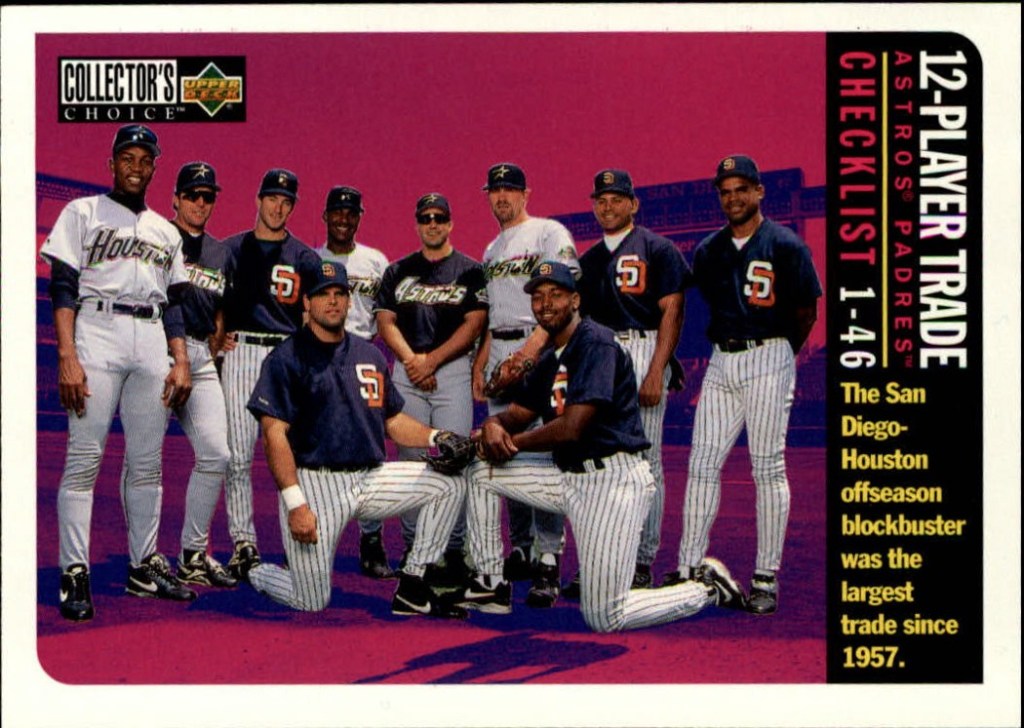
On December 28, 1994, the Astros and Padres executed a massive 12-player trade involving names that would be well-known throughout baseball for years to come.
But massive as it was, this trade stood out in retrospect for a number of reasons.
First, the haul for each team:
The Astros received: OF Derek Bell, RP Doug Brocail, SS Ricky Gutierrez, LHP(not that)Pedro Martinez , OF Phil Plantier and OF Craig Shipley.
The Padres received: SS Andujar Cedeno, 3B Ken Caminiti, OF Steve Finley, INF Roberto Petagine, RHP Brian Williams and LHP Sean Fesh.
Every player in this deal, minus Fesh, eventually played in the Major Leagues. Some more than others, but that fact alone makes this one of the more mutually successful trades in MLB history, especially given its volume.
Out of the six players Houston acquired, three of them became immediate major contributors — OF Derek Bell, SS Ricky Gutierrez, and RHP Doug Brocail.
The other three were minor and middling contributors.
Plantier, who could never replicate his powerful 1993 season which saw him hit 34 homers and drive in 100 runs, played 22 mostly productive games with Houston before being traded in July 1995… to San Diego. He never captured that ’93 magic again.
Shipley provided utility work off the bench during the 1995 season, then left via free agency, signing… with San Diego.
Martinez, who forever must preface himself as “not that one”, posted an unsightly 7.40 ERA in 20.2 innings at the big league level for Houston before being traded after the 1995 season concluded… to San Diego.
Gutierrez would become well-traveled after his five seasons in Houston concluded, ending his largely productive career in 2006 with 17 days… in San Diego.
Brocail would also eventually return to San Diego, but his journey was even weirder.
Before I get to that, have you noticed that Brad Ausmus hasn’t been mentioned here? He was on those 94/95 Padres teams, and yet he wasn’t in this deal.
Why is that important?
Because after his mid-season trade in 1996 from San Diego to Detroit, Ausmus was then packaged in a nine-player deal to Houston for a package including Brocail.
Four years and one day later, both Brocail and Ausmus, since traded back to Detroit from Houston following the 1998 season, were sent back to Houston in a six-player trade.
As for Brocail’s eventual return to San Diego, it happened via free agency prior to the 2006 season. He would turn in two seasons of work, with 2007 easily being the better of the two, before departing via free agency and signing with… the Astros, where he finished his career after the 2009 season at the tender age of 42.
That isn’t all, folks.
While the Astros enjoyed instant stardom from Bell, and consistent defensive work from Gutierrez, the Padres easily win this trade because of Ken Caminiti, who just also happens to double as my favorite all-time third baseman, thank you very much for asking.
The 1996 NL MVP was not just an instant contributor for the Padres, he was a star capable of highlight plays at the hot corner and heavy homer power in a lineup suddenly brimming with difficult outs.
Caminiti spent four seasons in San Diego, amassing the aforementioned ’96 MVP award, 121 long-dongs, three All-Star selections, and three Gold Gloves.
His Padres career was capped by their ascent to the 1998 World Series, which featured a stunning first-round defeat… of the 102-win Houston Astros.
After the ’98 season, Caminiti became a free agent and signed… with the Houston Astros, where he played for two seasons.
Steve Finley turned in two Gold Glove-winning seasons with a couple of high-powered seasons at the dish. After a rough ’98 season, the Padres let Finley walk in free agency where he eventually signed… with the Arizona Diamondbacks (I don’t blame you for thinking Houston. I did tee that one up.).
Finley would go on to help lead the D-Backs to the 2001 World Series championship… with former Astros Randy Johnson, Curt Schilling, and Luis Gonzalez starring alongside him.
Andujar Cedeno would go on to a mediocre stint in San Diego before being dealt in June 1996 to Detroit alongside… Brad Ausmus!
Cedeno’s career would end in 1996 with a tiny stint… in Houston.
Williams would return to Houston as well during the 1999 season for one go round, but never amounted to much at the big league level, though his return to the Astros did yield a career-high 50 appearances out of the bullpen to the tune of a 4.41 ERA.
Petagine never returned to Houston and never carved out a steady MLB career, but he did manage to touch seven seasons of Major League duty, which isn’t nothing.
Finally, we go to Sean Fesh, who never made it to The Show, but did play an impressive 17 seasons in affiliated minor league baseball, eventually returning to the Astros organization later in his career.
So, in summary, the Astros and Padres completed a massive 12-player trade in December 1994, with each team acquiring six players.
Of the 12 players swapped, 11 of them played at the Major League level.
Of the six players acquired by Houston, San Diego would eventually re-acquire five of them — three before the start of the 1996 season.
Of the six players acquired by San Diego, the Astros eventually re-acquired four of them.
Brad Ausmus, who was not part of the ’94 trade, ended up being involved in three different trades with two of the players in this deal, with one of them being traded both for and with Ausmus within a four-year span.
Between the two teams, five major contributors — Caminiti, Finley, Bell, Gutierrez, and Brocail — were involved, multiple Gold Gloves and an MVP award between them.
Both the Astros and Padres rose to prominence in the National League almost immediately after the trade and stayed there until just after the turn of the century.
Now THAT is an epic trade.
 Five Tool Talk
Leave a comment