
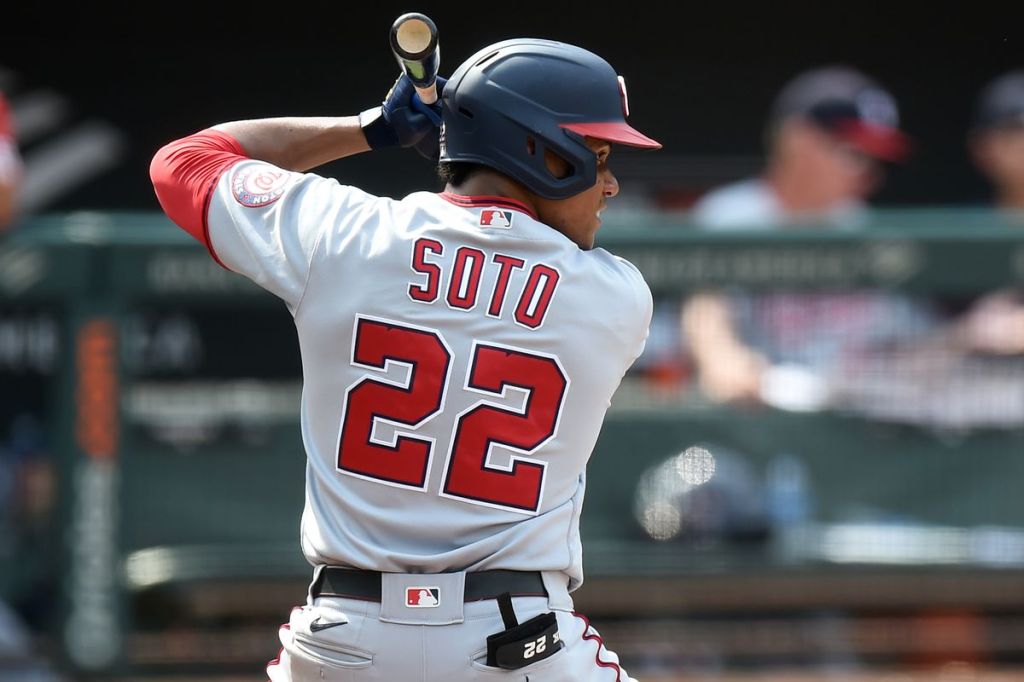
Let the Soto Sweepstakes begin!
As soon as Ken Rosenthal sent this Tweet, the baseball industry’s entire narrative on the eve of All-Star weekend was shifted to the young Nationals star, whose days in DC appear to be numbered.
Soto’s situation is profoundly unique given his age, production, current salary, years of team control remaining, and the total lack of leverage he would have in any potential deal.
Let’s be clear here – Juan Soto has not demanded or requested a trade from Washington, but his rejection of their latest offer leaves the Nationals with few options. It’s understandable on both sides why this has happened.
For the 23-year-old Soto, he’s already scored a World Series title, a second-place MVP finish, a batting title, 20.9 wins above replacement in only 554 career games, a scary-great career OPS+ of 160 (60 points better than league average), and a ridiculous career OBP of .427 with 452 walks against only 406 strikeouts in 1,920 career at-bats.
Somewhere, Brad Pitt is pointing at Jonah Hill as they say in unison, he gets on base!
That he does, and at a rate few have ever done it.
Even this season, amidst a first-half malaise at the plate that has seen him amass only a .250 batting average (43 points below his career mark), Soto’s OBP is an astonishing .406, which has carried his OPS to .896, and this is a bad year.
Soto isn’t leading baseball in much this season, but he has drawn a ML-leading 79 walks, which means his batting eye is still as good as ever.
Much like an NBA superstar whose shots aren’t falling in a particular game, Soto finds other ways to help his team at the plate, posing so much of a threat still that even when the ball isn’t falling for him (he’s currently sporting a .247 BABIP, which is 66 points below his career average), he still gets on base and produces run opportunities for the Nationals.
The problem, of course, is that the Nationals, the 2019 World Series champions, resemble nothing of that resilient title team that came from a 19-31 start to stun the favored Houston Astros in the Fall Classic.
As Soto has continued churning out superstar performances, the Nationals have dealt away all the pieces that made up ’19’s title team.
Gone are Max Scherzer, Trea Turner, and Ryan Zimmerman via trades and retirement, while injuries and underperformance have turned the contracts of Stephen Strasburg and Patrick Corbin into 10-ton organizational paper weights.
Still, the Nationals have tried in vain to lock-up Soto, hoping to retain their superstar with the vague promise of a better and brighter tomorrow in a few hundred tomorrows.
It hasn’t worked.
So why didn’t 15 years and $440 million work?
From DC’s point of view, this is a landmark offer, far exceeding anything they’ve ever offered to anyone in terms of everything – years, total value, and AAV.
It’s a serious offer.
For Soto, the AAV of $29.33 million is nothing to sneeze at, but it’s far from historic (ranking 20th among players now) and it locks Soto’s earning power in until his age-38 season.
Clearly, Soto will be able to top that either on the open market or via trade to a new team, barring injury.
It’s unclear what Soto’s ideal contract looks like, but it’s clear that more than Mike Trout should be a starting point.
For those in need of a refresher, Trout received a 12-year, $426.5 million contract extension in March 2019, the largest contract ever signed in North American team sports history, with an AAV of $35.5 million.
Remember, Soto is just 23. His peak is likely still ahead of him. He has every right to expect even more for a generational talent such as his.
But Soto isn’t close to free agency, and that’s what makes Washington’s decision to listen to offers clearer.
Unlike their flaccid attempts to retain Bryce Harper before him, the Nationals have gone all out to keep Soto in the fold and to reward him early for his seismic, franchise-altering contributions.
As their efforts continue to hit dead-ends, the Nationals have had to take stock:
- Bad big league team
- Below-average farm system
- Big contracts on the books that they wholeheartedly regret (Strasburg and Corbin)
- Questionable ownership situation
- Soto’s currently under 2.5 years of team control as of this moment, maximizing his trade potential.
Look, the Nationals are 31-63 at the All-Star break and need to begin looking for ways to expedite the rebuilding of their organization from the bottom-up.
While the Nats could always improve AAV of their most recent offer, or amend it in some other way desirable to Soto, the precision-leaking of their willingness to listen to offers is the surest sign yet that Soto, and his singular greatness, are soon to go.
Soto voicing his displeasure at the Nationals’ clearly leaking not just the offer, but the openness to a trade prior to his victory at the Home Run Derby on Monday night, only serves to ensure an ugly divorce.
“It feels pretty tough,” Soto said at the All-Star Game media day on Monday . “Pretty frustrating, because I try to keep my stuff private. (I) don’t try to throw stuff out there. It feels really bad, but at the end of the day we just got to keep playing.”
Soto reiterated that his preferred destination is where he currently resides, but that he would adapt quickly if dealt.
So where to? What kind of trade package would it take to pry him loose? Is there even a precedent for this?
Yes and no.
Miguel Cabrera‘s trade from Florida to Detroit prior to his age-25 season is perhaps the lone example of a player of Soto’s stature being traded in his prime, or near it, but even Cabrera’s case is ill-fit for comparison as a few things have changed in baseball since this trade was consummated in December 2007.
- Virtually all GMs today are of an analytical, Ivy League-educated bend. Detroit basically pulled this deal off with manager Jim Leyland sitting in the corner of GM Dave Dombrowski’s office, puffing on his fourth Marlboro Red in the span of an hour, side-eyeing Dombrowski every few minutes with a look that said, pull the trigger.
- You’re likely to never see a more lopsided, who-gives-a-shit return for a bonafide future Hall of Famer in his prime than the one the Marlins got for Cabrera and LHP Dontrelle Willis: LHP Andrew Miller, OF Cameron Maybin, C Mike Robelo, RHP Burke Badenhop, RHP Frankie De La Cruz, and RHP Dallas Trahern.
- It took two hours for Detroit to accept this offer. Adjusted for inflation, that same offer would be accepted in 0.000000002 seconds.
Cabrera was certainly comparable to Soto during his exquisite Florida run, as evidenced by his 18.3 wins above replacement during his tenure, but Soto is still better, younger, and exists in a time where everyone is crunching the numbers and weighing every move to the gram.
Three Scenarios
One of the most valuable new tools for fans to cast their trade dreams upon is over at Baseball Trade Values, where exhaustive statistical analysis is used to measure the trade value of over 2,700 players, from stars to obscure prospects.
Soto’s median trade value is an astronomical 176.8, which makes it difficult to find packages out there that match up.
The site’s founders claim to have studied hundreds of previous trades to attempt to perfect their formula for valuation, so it feels like the best predictive tool available for such an unprecedented situation.
Padres
One intriguing scenario comes from San Diego, who after falling flat last season despite lofty expectations, certainly have the capital to make a Soto trade a reality.
SD trades (188.80): SS C.J. Abrams (50.3), INF Jake Cronenworth (54.9), LHP MacKenzie Gore (37.9), OF Robert Hassell (38.7), and LHP Taylor Rogers (7)
WAS trades (176.8): OF Juan Soto (176.8)
A trade like this is perfect for the Padres. As Fernando Tatis Jr. continues his rehab towards a hopeful return in early August, the Friars will survive the sudden loss of infield depth with Cronenworth packaged out along with Abrams, pairing Soto with Tatis and their star on the hot corner, Manny Machado.
Any trade of this magnitude will cost a ton, and the Padres losing Gore, Abrams, and Hassell in one trade would feel terrible in most any other case, but this is Juan Soto.
On the Nationals’ side, this is a no-brainer. Four elite, cost-controlled talents along with a serviceable southpaw for the pen.
Rogers isn’t necessary for this deal, but bad teams love grabbing that extra reliever in trades. No idea why.
Dodgers
LAD trades (128.0): OF Cody Bellinger (1.4), INF Miguel Vargas (26.9), C Diego Cartaya (56.2), OF Andy Pages (25.3), and RHP Ryan Pepiot (18.2)
WAS trades (122.40): OF Juan Soto (176.8), OF Victor Robles (0.5), and LHP Patrick Corbin (-54.9)
The beauty of having the best club in the National League and one of baseball’s premier farm systems is that the Dodgers can get endlessly creative in their pursuit of Soto.
In this scenario, LA mortgages a chunk of their future by dealing away four of their best and brightest youngsters along with the 2019 NL MVP, who could perhaps use a change of scenery since his descent started in the COVID-shortened 2020 season.
Like Bellinger, Patrick Corbin has fallen off a cliff since his title-winning first season in Washington in 2019, going 15-35 since 2020 with a 5.45 ERA and, counting all of this current season, $83.25 million still on the books through the 2024 season.
At 32, it’s not inconceivable that Corbin could find his way back to respectability, and MLB teams will always give southpaws with a track record and a pulse a chance to make good.
Part of the problem with making a realistic offer for someone like Soto is that you either give up the farm and then some, or you take back something undesirable to lessen the haul you’re surrendering.
In this scenario, even with LA surrendering four of their top six prospects, they still need to take back Corbin just to balance out the numbers. Remember, this will be a race for Soto, so the Nationals should come out on top, numbers-wise, in any deal.
Blue Jays
TOR trades (184.40): RHP Alek Manoah (114.5) and C Gabriel Moreno (69.9)
WAS trades (176.8): OF Juan Soto (176.8)
So simple, so easy. It almost makes too much sense for the Nationals to take a new, elite, controllable battery and call it a done deal.
Manoah, 24, is controllable through the 2027 season and, through 38 career starts, has posted a 19-6 record with a sterling 2.74 ERA in 226.1 IP.
So far this season, the newly-christened first-time All-Star is 10-4 with a 2.28 ERA, a BAA of .205, and a baffling WHIP of 0.959.
Moreno, 22, debuted on June 11 and is only 18 games into his ML career. That said, the converted infielder is a truly elite two-way player with gobs of potential.
The Nationals acquired their catcher of the future in Keibert Ruiz last summer in the Scherzer/Turner deal with LA, but Moreno is the kind of player that you don’t turn away from.
The only reason a trade such as this fails to be conceived is because Toronto would be surrendering their clear ace with a stumbling and expensive Jose Berrios left to pick up the pieces.
New York, New York?
I know what you’re thinking – why are you not drawing up scenarios for the Yankees and Mets?
For the Yankees, using this construct, even a deal in which they deal away their best prospects – Jasson Dominguez (14.9), Oswald Peraza (20.3), and Anthony Volpe (56.2) – an unlikely scenario, the Yankees would still need to take back a crappy contract like Corbin (-56.2) and it still wouldn’t be enough.
As for the Mets, I just do not believe the Nationals will go all-out to piss their fans off by both trading Soto and then compounding that by sending him to a division rival for him to torment the Nats and their fans for years to come.
When looking for a potential Soto match, one needs to think outside the usual suspects.
For starters, Soto is 2.5 years away from free agency and is currently making “only” $17.1 million.
As baseball employs a new extended postseason this season, there are more teams looking to improve and Soto is the kind of generational difference-maker that teams will make crazy moves for.
If Soto is traded prior to the August 2 trade deadline, it will not be the kind of deal that necessitates an extension. Remember, Juan Soto just turned down a 14-year, $440 million deal.
Any team acquiring Soto will get, presumably, three postseason runs with him and then they can either watch him leave for his monster contract elsewhere or they can sign him themselves and hope it becomes the first-ever monster contract a team doesn’t end up regretting.
“He’s at the top, he is the best of the best,” said Scott Boras, Soto’s agent, as per MLB insider Hector Gomez.
Boras continued, “nobody in his first four years has had the success that he has had at that age, he is a great value for any franchise. We’ll see which team will pay what he is worth.”
There is no arguing Soto’s immense value, but matching it in a trade to the liking of the Nationals will be a whole other issue.
Are teams comfortable giving up the farm for three postseason runs? Will the acquiring team be interested in an extension?
Deep in the heart of Texas?
One obvious potential landing spot is with the team Soto helped sink in the ’19 World Series, the Houston Astros, but that becomes a two-pronged issue right off the bat.
Will the Astros change their stance on contracts longer than five or six years for Soto if they acquired him?
Would Houston be willing to meet Washington’s price, which in all likelihood would call for a package revolving around All-Star outfielder Kyle Tucker, starters Luis Garcia and Cristian Javier, as well as utility prospect Pedro Léon?
Because, in lieu of minor league prospects of note, minus RHP Hunter Brown who is currently toiling away in Triple-A, awaiting either a shift in the team’s depth chart or a trade elsewhere, the Astros’ best shot at acquiring Soto lies in big league talent.
The Astros have an abundance of starting pitching depth, though the quality of it can waver from time to time. Are they willing to deal from it for a player like Soto?
A deal with Houston is difficult to conceive for both sides, so I’m leaving it out without entirely ruling it out.
This is all so strange and seems like more of an anomaly than a new course being charted for future superstar movement. The Nationals didn’t balk at the years like so many teams do, and they ponied up the cash as well, just not enough.
I suppose the big question here is should Juan Soto have taken the money and run, locking in massive earnings until age-38 and protecting himself from potential injury?
Maybe, but a player like Soto is bound to age well. The things he excels at, pitch recognition and strike zone control, will be with him no matter what.
Soto is a serviceable corner outfielder, but with the universal DH now firmly in place, the idea that Soto can produce at an elite level well into his 30s is far from inconceivable. All 30 teams now have a tool to protect players like Soto.
The clock has now officially started on front offices around baseball to weigh all of these factors and decide if the potential two-way cost of Juan Soto (players and money) joining their team is the kind of juice that is worth the squeeze.


Leave a Reply